Senolytic Pulse Protocol

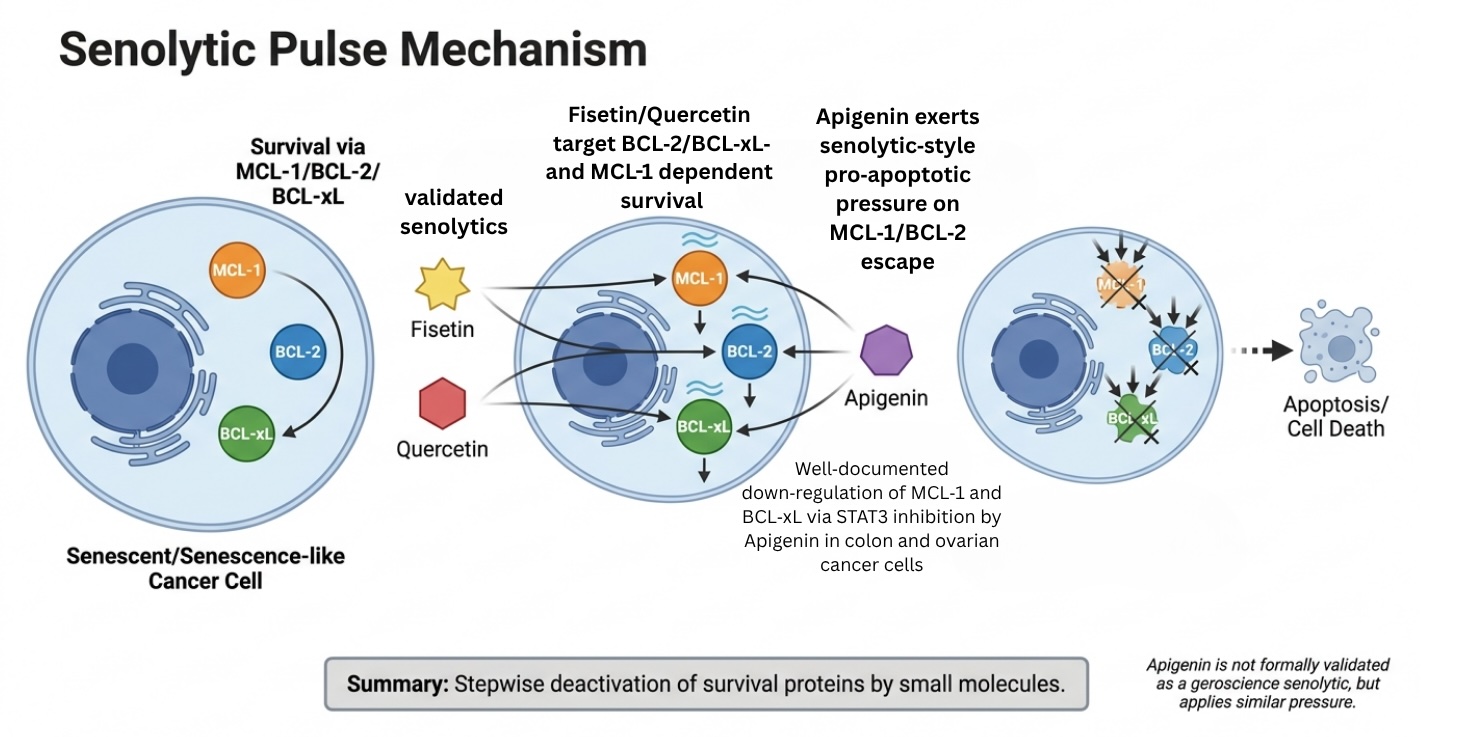
Conservative, patient-facing framework for intermittent natural senolytic-style pulses built around fisetin and quercetin, with apigenin adding extra pressure on escape routes

In this section

Read Senescence — The Second Escape Route before using this guide.

That page explains why this protocol exists. It covers therapy-induced senescence, how SASP can keep damaged cells biologically active, why some senescent cells may later escape, and why senolytics are framed here as a second-strike follow-up rather than a primary treatment.

Scope and intent

This guide is designed as a conservative, patient-facing framework for discussing intermittent natural senolytic-style pulses built around liposomal fisetin, liposomal apigenin and quercetin, using currently available human dosing patterns as the foundation.

It should be read after Senescence — The Second Escape Route.

That background page explains the core logic behind this protocol. Some treatment-stressed cancer cells stop dividing without dying, stay metabolically active, release SASP signals, and may later re-enter growth. This protocol is written as a cautious follow-up framework for that senescent survivor problem.

It is not a clinical trial protocol and should be presented as a translational guide rather than as a validated treatment standard.

Human dosing patterns that inform the framework

Two human patterns are the clearest anchors for intermittent natural senolytic use.

In the osteoarthritis trial NCT05276895, the natural senolytic arm used quercetin 1250 mg/day plus fisetin 1000 mg/day for 3 consecutive days every 3 weeks over 12 weeks.

In fisetin-focused human studies and summaries of Mayo-style senolytic protocols, fisetin has commonly been used at 20 mg/kg/day for 2 consecutive days as a pulse schedule.

These human patterns support a "hit-and-run" approach rather than continuous daily use.

The practical implication is that intermittent higher-dose exposure is the closest human evidence base currently available for natural senolytic-style protocols.

Product-based conservative translation

The products considered here are MCS Formulas Fisetin Pro Liposomal, which provides 150 mg fisetin per capsule with a phospholipid and chitosan LongLifeLipoTech™ delivery system, MCS Formulas Quercetin & Bromelain, which provides 400 mg quercetin per capsule with bromelain included to support oral absorption and MCS Formulas Liposomal Pro Apigenin which contains 200mg apigenin in each capsule.

Because the fisetin and the apigenin formulas uses a proprietary pro-liposomal phospholipid plus chitosan system intended to improve absorption and circulation time, a conservative translation is more appropriate than trying to capsule-match the non-formulated trial doses one-for-one.

Human literature also supports the broader principle that enhanced extract formulations can materially improve oral bioavailability compared with unformulated extracts.

A cautious working assumption is to treat the liposomal formulas as potentially more efficient per milligram than standard powder, then begin below the full trial-equivalent load and escalate only if well tolerated.

This is especially reasonable for mixed community groups that include older adults, post-treatment cancer survivors, and people with higher inflammatory burden or supplement sensitivity.

Dosing guide using these formulas

Option 1: Conservative entry pulse

Use this for first exposure, sensitive individuals, older adults with multimorbidity, or post-treatment patients where tolerability matters more than intensity.

Days 1-2: Fisetin Pro Liposomal 2 capsules twice daily, total 4 capsules/day = 600 mg fisetin/day.

Days 1-2: Quercetin & Bromelain 1 capsule twice daily, total 2 capsules/day = 800 mg quercetin/day.

Days 1-2: Apigenin Pro Liposomal 2 capsules twice daily, total 4 capsules/day = 800 mg apigenin/day.

Take doses approximately morning and early afternoon, ideally away from the evening if sleep sensitivity is a concern.

Repeat no more often than once every 4 weeks for an initial 2 to 3 cycles.

This entry pulse stays well below the nominal fisetin trial-equivalent target while still preserving the intermittent senolytic-style structure.

It also lands quercetin within the range used in multiple human oral studies while keeping total pill burden manageable.

Option 2: Intermediate pulse

Use this when the conservative entry pulse is well tolerated and a stronger trial-aligned exposure is desired.

Days 1-2: Fisetin Pro Liposomal 3 capsules twice daily, total 6 capsules/day = 900 mg fisetin/day.

Days 1-2: Quercetin & Bromelain 1 capsule three times daily, total 3 capsules/day = 1200 mg quercetin/day.

Days 1-2: Apigenin Pro Liposomal 3 capsules twice daily, total 6 capsules/day = 1200 mg apigenin/day.

Space doses across morning, midday, and mid-afternoon where possible.

Repeat every 3 to 4 weeks.

This option approximates the quercetin exposure used in the osteoarthritis senolytic trial and moves fisetin closer to published pulse targets while still accounting for the possibility of better delivery with the liposomal/chitosan system.

For many users, this is a more realistic balance between evidence alignment and capsule burden.

Option 3: Three day quercetin-forward pulse

Use this when the aim is to mirror the structure of the osteoarthritis trial more closely, while still applying a conservative translation for formulated fisetin.

Days 1-3: Fisetin Pro Liposomal 2 capsules twice daily, total 4 capsules/day = 600 mg fisetin/day.

Days 1-3: Quercetin & Bromelain 1 capsule three times daily, total 3 capsules/day = 1200 mg quercetin/day.

Days 1-3: Apigenin Pro Liposomal 2 capsules twice daily, total 4 capsules/day = 600 mg fisetin/day.

Repeat every 3 weeks.

This preserves the 3-day pulse rhythm of the human Q+F trial and places quercetin close to the studied 1250 mg/day level.

It deliberately keeps fisetin and apigenin below a simple capsule-for-capsule conversion of non-formulated trials because the liposomal pro formulation is intended to improve absorption and slower exposure characteristics.


When senolytics cannot work optimally

Senolytic-style pulses do an important part of the job: they help push senescent or damaged cells toward apoptosis or other “off” pathways, but the actual clean‑up still depends on immune, liver, kidney, and lymphatic clearance.

Anything that markedly suppresses immune function, overwhelms liver and kidney handling, or keeps inflammation chronically high may reduce how efficiently that debris is recognised and removed.

Practical “brakes” can include very low vitamin D status (impaired NK‑cell and macrophage function), very poor sleep, ongoing hepatotoxic drug load, severe constipation, and acute infections or flares where the body is already struggling to keep up with inflammatory clearance.

In those situations, it is reasonable to lean into gentler support cycles first and delay or soften a pulse until recovery and basic clearance capacity have improved.


Supporting the body’s clean‑up phase

Once a pulse has nudged senescent cells towards exit, the priority shifts to helping the body process and escort that cellular debris out as calmly as possible.

This is where the “Category 3: Supporting / Adjunct Roles” options become especially relevant: they are not senolytics, but they can help the liver, immune system, and clearance pathways cope with the transient increase in senescent‑cell burden.

For example, silymarin/milk thistle is positioned here for its role in supporting hepatocyte resilience, modulating stress pathways like NF‑κB, and assisting liver handling of increased apoptotic and metabolic load during and after pulses. TUDCA is also a great way to support the liver after a senolytic pulse.

Vitamin D3 with K2 fits as a background co‑factor for immune surveillance, with human and mechanistic data linking adequate D status to more competent NK‑cell and macrophage function in clearing senescent or apoptotic cells.

Gentle movement, hydration, bowel regularity, and prioritising sleep in the 48–72 hours around a pulse can be framed as simple, low‑tech ways of giving efferocytosis, lymphatic flow, and organ clearance the best chance to quietly do their work.

Trusted supplier

MCS states that their apigenin and fisetin purity is tested by Eurofins prior to manufacturing and highlights no fillers are ever used in their capsules.

These formulas are delivered in a dry pro-liposomal capsule that combines phospholipids from sunflower lecithin with chitosan to support formation of neutrally charged liposomes.

MCS states that this LongLifeLipoTech™ system is intended to maximize absorption and improve biocompatibility, while published fisetin pharmacokinetic literature independently supports the general need for liposomal formulation strategies because unformulated fisetin has poor oral bioavailability. Learn more about the advantages of liposomal delivery here.

The quercetin product is not liposomal, but pure bromelain extract is included to support quercetin absorption after oral administration.

COMT note for protocol use

Slow-COMT individuals may be more likely to experience overstimulation, irritability, anxiety, or sleep disruption from quercetin-containing pulses because quercetin is commonly described as a COMT-inhibiting flavonoid in genotype-oriented supplement guidance.

Fast-COMT individuals often tolerate this category better, but there are no senolytic trials that adjust fisetin or quercetin pulse dosing by COMT genotype.

A simple protocol note is to begin with the conservative entry pulse for anyone with known slow COMT, anxiety, insomnia, stimulant sensitivity, or high reactivity to polyphenols.

Fisetin-only pulses can also be considered first where quercetin sensitivity is suspected.


MCS Formulas provides the Study Support Group with a 5% Discount Code: abbey5

References by category

Product specifications and manufacturer pages

Bioavailability background

COMT considerations

Would you like to ask Abbey about the information shared on this page? Would you like to contribute your experience, research or ideas to this page? Perhaps you want to point out something that needs changing?

Feedback Form

© 2026 Abbey Mitchell. All rights reserved. Please share by URL rather than copying page text.

Last updated

Was this helpful?